Category: edsa

Reinventing EDSA

agree with luis teodoro that “EDSA 1986 was truly revolutionary — and it is for that reason that, though they have never found the words to explicitly say it, the power elite fear it.” it is also why enrile has tried to re-invent it in terms of “military primacy”. i say it’s time we the people reinvent EDSA, level up the non-violent activism, get our acts together, in the run-up to 2022.  #hopespringseternal

 LUIS V. TEODORO

The 35th anniversary of the 1986 civilian-military mutiny known as EDSA I — or as its participant-adherents then called it, the People Power Revolution — that overthrew the Ferdinand Marcos dictatorship and forced him and his family to flee to Hawaii, USA came and went this year with hardly anyone noticing.

Feb. 25 has become for most Filipinos just another anniversary of this or that incident in history whose meaning has eluded them for years, or the birth or death date of someone they were told in elementary school did something that made him a hero. Exactly why an incident or a certain date is important is something they haven’t bothered to find out. Jose Rizal? Didn’t he have a girl in every port? Tirad Pass? Is that where that anti-American guy died? And EDSA 1986? Wasn’t that the incident that ended the administration of the best president the Philippines has ever had?

As in previous years, only the usual platitudes and motherhood statements emanated from Malacañang Palace. It was as if the biggest bureaucrats in government feared that saying something meaningful could educate the mass of the citizenry enough for it to harbor such dangerous ideas as that they’re the true sovereigns of this country and that government officials serve at their pleasure. That’s as likely to happen as this country’s making it out of the Medieval Ages and into the 21st century, but one could almost hear President Rodrigo Duterte asking his staff if it’s that time of the year again, and can’t we just forget about EDSA I?

Not that Mr. Duterte has ever given the event any importance. Since 2017 he has studiously avoided attending any ceremony marking its anniversary, thereby pointedly sending his followers the message that it is really nothing to celebrate. It makes perfect sense for a president who counts the surviving Marcoses among his most reliable partisans and closest allies. But beyond the demands of that alliance — and even his declared preference for defeated 2016 vice-presidential candidate Ferdinand “Bongbong” Marcos, Jr. to succeed him should he decide not to complete his six-year term — is the fear of an EDSA I repetition, or even of the year 2001’s EDSA II, when another president, Joseph Estrada, was also removed from office through direct people’s action.

Although referred to as a “revolution,” EDSA 1986 was true to that word only in one sense. It certainly was not an economic revolution, since it didn’t transform the economic system. The land tenancy anomaly survived it and even emerged stronger than ever; inviting foreign investments into the country is still the main development strategy of Marcos’ successors as it has been since 1946; and industrialization has never been seriously contemplated as economic policy. Neither was that “revolution” a social upheaval: it did not end the vast inequality, the social injustice, and the poverty that still afflict millions of Filipinos.

But it was a moment of mass empowerment, the precedents of which go back a hundred years to the Reform and Revolutionary periods of Philippine history. For the first time since the country declared its independence, and after decades of tolerating corrupt and incompetent misgovernment from 1946 onwards, some two million Filipinos braved the tanks, the helicopter gunships and the mercenary soldiery of a murderous dictatorship to declare that they had had enough of the human rights violations, the torture, the enforced disappearances and the extrajudicial killings of the regime, and that it was time to end the lies and the deceit of a self-serving kleptocracy that had brought only dishonor to this country and suffering to its people.

It was in that sense that EDSA 1986 was truly revolutionary — and it is for that reason that, though they have never found the words to explicitly say it, the power elite fear it. 

Mr. Duterte is not alone in wishing it and its example away. His predecessors were equally focused on getting the people to forget both EDSAs, and for entirely the same reason.

Although he was one of the leading figures of EDSA 1986, former President Fidel Ramos, for example, repeatedly discouraged its repetition supposedly because the political instability it would signify would discourage foreign investments. Joseph Estrada’s removal from office via EDSA II naturally made him, his family, and his allies leery of anything similar, while Gloria Macapagal-Arroyo allegedly contemplated declaring martial law out of fear that an EDSA III could depose her.

Himself accused of fomenting a military putsch during the coup-plagued presidency of Corazon Aquino, former Senator Juan Ponce Enrile, instead of discouraging the celebration of EDSA I as well as EDSA II, encouraged remembering both differently. Like Ramos, he was, after all, also one of the 1986 event’s leading figures, and apparently believed that something similar could propel him to power. Rather than admit that what overthrew Marcos in 1986 and Estrada in 2001 was the people’s direct action, he declared at some point when he was eying the Presidency that it was the military that had done the deed.

That claim is only partly true, however. Elements of the military were indeed involved in both uprisings, but without the millions massed at Quezon City’s Epifanio de los Santos Avenue (EDSA) between Camps Crame and Aguinaldo, those rebel units would have been overrun by the superior numbers of Marcos’ military loyalists. It was civilians — nuns and priests and middle-class folk — who faced Marcos’ tanks and shielded Ramos, Enrile, and their military cohorts from being attacked and annihilated in 1986.

It was also an event 14 years in the making. Without the heroic efforts of Church people, journalists, writers, teachers, students, artists and many other sectors to provide the citizenry from day one of martial rule, the information that finally led millions of men, women and even entire families to mass at EDSA from Feb. 22 to 25, the dictatorship would have prevailed. The same commitment of the same sectors was similarly indispensable to the success of EDSA II.

As untenable as Enrile’s re-invention of EDSA I and II may be, it seems that Mr. Duterte is of the same view, although not necessarily because of Enrile’s say-so, and without publicly admitting it. The same assumption of military primacy as Enrile’s is evident in his unending courtship of the officers corps — his packing his government with retired generals, and his putting the interests and welfare of the soldiery above those of everyone else’s in terms of perks and salaries. Rather than the people shielding him from the military, it would seem that Mr. Duterte is anticipating the possibility that the military might have to shield him from the people.

But could he be mistaken in assuming that the military will be true to him no matter what the cost? There are no indications so far that it won’t be. And as for the possibility of something like another People Power uprising occurring, that, too, seems hardly likely. After decades of disinformation and forgetfulness, the Filipino masses have yet to learn the revolutionary lesson as well as the meaning of both EDSA events.

Mr. Duterte and company are in the rare and privileged position of being protected by both the seemingly boundless loyalty of the military and the cluelessness and apathy of the heirs of a generation that brought down a seemingly invincible tyranny. That makes it so much the worse for the future of the interminable work-in-progress that is Philippine democracy.
Historical revisionism and fake news

Amelia H. C. Ylagan

History is always the most revered authority, and the ultimate teacher. It is empirical proof of expected results from conditions and contexts as naturally presented by science or as conjured and executed by minds. What has happened, has happened, and there is always a lesson learned.

But the life that History gives to concepts and principles can be limited not only by the durability of physical archives but the fickleness of minds — who may carelessly forget lessons learned, or, worse, actively tamper with facts and data to suit biases and whitewash personal culpability in the deconstruction and revision of what may be a notorious Past.

An example of negative historical revisionism is David Irving’s controversial book, Hitler’s War (1977), where the dictator Adolf Hitler is shown as innocent of the Holocaust and that only Heinrich Himmler and his cohorts masterminded and executed the genocide of six million Jews in Nazi Germany between 1941 and 1945.

Are Filipinos about to accede to a revision of history over the 14 year-dictatorship of Ferdinand Marcos — editing out as well the glorious EDSA People Power Revolution that ended the most notorious period that killed about 3,240, imprisoned 70,000, and tortured 34,000 people from 1972 to 1981, according to data of Amnesty International?

On the 48th anniversary of Marcos’ declaration of Martial Law, an online conference on historical revisionism titled “Balik Ka/Saysay” was held from Sept. 21-25 by the Ateneo University-based Asian Center for Journalism (ACFJ) and Consortium on Democracy and Disinformation, in partnership with Tanggol Kasaysayan and Bulatlat. The conference focused on disinformation and the machinations of politics, on the inadequacy of education, and extensively described the exacerbating influence of social media and fake news on perception and the formation of new mores and values.

Keynote speaker at the ACFJ webinar was novelist Lualhati Bautista (Dekada ’70 and Gapo) who went underground during the Marcos martial law, and despite the strict censorship imposed by the government, wrote about the anxieties and fears of ordinary Filipinos in those tremulous times. “Never forget; never again!” was her heart-wrenching message. But for those listening to her recounting of the hounding and torture of those who defied Marcos then, her horrible reminiscences might have fallen differently on unreceptive ears of those who did not directly experience martial law. How devastating to hear a young reactor at the conference, a self-proclaimed “fan” of Ms. Bautista for her art, dismissing the pathos of a dark history by concluding a long-winded to-and-fro on doubting what may be “exaggerations” in the telling of the martial law situation then. “It is not my context,” she might have said in so many words, as she quite directly insinuated to this aghast listener who has seen Lualhati Bautista’s horrible scenarios in the context of 48 years ago.

“It is not my context” is the obvious indifference of most of the younger generation that did not see the excesses and horrors of martial law played out in reality. Adding cold emotion to whatever near-boiling empathy might be brought by stories told by seniors is the obtrusive social media virtual reality replete with ready fake news that the younger generations might have made its instant real Reality — their “context.”

At the Cultural Center of the Philippines (CCP) theater showing early in the year of Kingmaker, a documentary by Emmy-winning filmmaker Lauren Greenfield about former First Lady Imelda Marcos, an open forum was held mainly to wrap up for attending groups of students from various schools, the “Never Again” information campaign of rights groups to educate the younger generation about the perils of autocratic government. Resource person Etta Rosales, tortured and imprisoned in Martial Law, gave inputs and answered questions from the students. It was the same basic concern of the Youth: “What is in it for Me?”

Recalling that open forum, and reviewing the ACPJ conference on historical revisionism, it sends chills through this older person to realize that a better way must be found to protect those who have not personally experienced Martial Law and its excesses from the frightful chimera of History repeating itself. The protective instinct of the Elders must work within the context of the Youth, in their Reality and in their Present — and perhaps resignedly acquiesce to their focus on “What is in it for Me.”

University of the Philippines Professor Francisco A. Guiang in a comment about historical revisionism cites the historian Carl L. Becker who said that “Every generation writes its own history… we build our conceptions of history partly out of our present needs and purposes…” (1955). Hence, while the older generations might be concerned about the immoral revision of their history, the younger generations are focused on writing their own, based on their present needs and purposes, their values and principles, taught to them by their parents by example, or by individual collective experiences and environments.

It must be admitted that in the 14 years of the Martial Law experience, victims and beneficiaries all have been writing history by the acceptance, refusal or compromises made then, and many have effectively rewritten and revised that history in the 34 years after the euphoric EDSA People Power Revolution, directed by changing individual and collective present needs and purposes. Some guilt might lie in admitting that the older generations might not have shown good example and firm guidance to the younger generations as to the values and principles that urged the collective judgment then that martial law the way Marcos did it was wrong and unconscionable.

Why did the Filipino people allow President Rodrigo Duterte to bury the dictator Ferdinand Marcos in the Libingan ng Mga Bayani? We have revised History. Marcos is now a hero.

The Marcoses plundered the country’s coffers, with various estimates putting the amount at between $5 billion to $10 billion, as reported by ABS-CBN in 2017. The Presidential Commission on Good Government (PCGG), the body going after the Marcoses’ ill-gotten wealth, is still recovering this money; over the past 30 years, at least P170 billion have been recovered. The Supreme Court dismissed in 2018 a civil suit seeking the recovery of over P50 billion in moral damages and P1 billion in exemplary damages sought by the PCGG over the Marcoses. The Sandiganbayan in 2011 junked the case, saying the PCGG failed to prove that the defendants connived to amass ill-gotten wealth.

In 2008, former First Lady Imelda Marcos was acquitted of an $863-M corruption case involving 32 counts of illegally transferring wealth to Swiss banks abroad during her husband’s 20-year rule. Would you wonder why the documentary Kingmaker did not jar the young viewers at that open forum held after the screening, despite the first-person account of Etta Rosales of her torture during Martial Law? Imelda is guiltless. History has been re-written.

It seems that the onus of responsibility to keep the integrity of history clearly rests on those survivors of Marcos’ Martial Law. Alas, so few of the older generation still have the passion to pursue the noble upholding of the Truth. At least those who still care that History must not repeat itself for the younger generations must devise and design active ways, albeit from physically deteriorated capabilities (but still-solid minds) to inculcate values and principles above present needs and wants of the younger generations.

The best way can only be to always visibly and audibly, strongly oppose corrupt and immoral practices in present-day government and society in general that, in the wisdom of age and experience, can be a useful template for the younger generations. The older generations are still writing their history, and their legacy.

Amelia H. C. Ylagan is a Doctor of Business Administration from the University of the Philippines.

happy EDSA day!

from Ronald U. Mendoza on Facebook:

Some people seem to think so very little has changed since 1986. Not true. Under the dictator: almost 60% poverty (today it’s at 17%); debt of at least 90% of GDP (today it’s down to 40%); vibrant insurgency (back then well over 20,000 NPA compared to roughly less than 4000 today); sick man of Asia reputation (now investment grade credit rating), to name a few stark differences. We successfully left all of that thanks to EDSA. Sure, our institutions are still imperfect, but we are far from the basket case we were under the dictatorship.

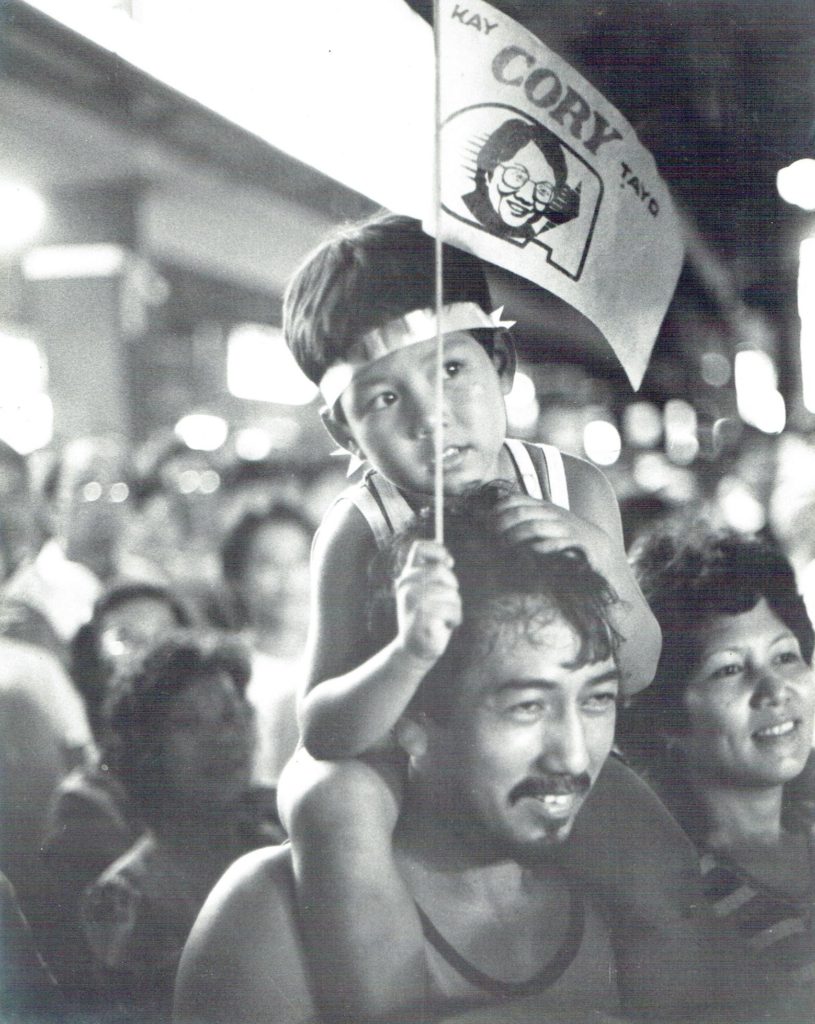
While we still face many challenges, at the very least, that boy (now a man) has one less big problem today — that dictatorship that we should never return to again. That’s good enough downpayment by those brave parents, who helped give the next generation a fighting chance to keep building this democracy. Please stop thinking that EDSA was supposed to solve all our problems. That kind of reasoning is a form of absolutist thinking — and that’s what history re-inventers are banking on.

Every generation faces a challenge worthy of its best nature — our parents’ generation who fought to kick out a dictator and restore democracy, and our generation’s fight today to protect that democracy and keep building it.

Photo credit: Steve Rodgers.

debunking tiglao  #EDSA #1986

i’m sure rigoberto bobi tiglao has a copy of my EDSA Uno book because he asked katrina for one when she was still with the manila times.  so, really, nakakataas ng kilay at medyo katawa-tawa ang kanyang Five facts about EDSA we didn’t know at the time.  napaka-selective and kind of twisted, in aid of putting down cory and EDSA and / while touching up the images, toning down the martial-law tainted vibes, of enrile and marcos in the time of EDSA.

historical revisionism to the max, with overtones of machismo.  all of thirty-three years later and these guys still can’t stop whining, and their tall tales get even taller.  hindi pa rin nila matanggap na naungusan sila, naisahan sila ni cory, fair and square, in those 10 shining days of the february boycott that saw the blooming of EDSA and the ousting of marcos.  get over it, guys.

TIGLAO:  Cory Aquino had little to do with EDSA 1.

CHAROT.  this is only a variation on enrile’s cory-was-not-even-in-EDSA line, and it’s also not true.  she was there for a while, in person, on the afternoon of day three 24 feb – long enough to pray the our father and sing bayan ko with the crowd in front of POEA  (reported by manila bulletin 25 feb).  thing is, she didn’t even need to make an appearance.

from the start, cory was all over EDSA in spirit – when the people trooped to EDSA they were wearing cory’s colors and waving her flags, and they were still on crony-boycott mode, demanding that marcos resign so cory could take over.

kung hindi kay cory na nilabanan si marcos sa snap election, kung saan dinaya siya ni marcos, kung kaya’t nagprotesta siya sa luneta at buong tapang na iginiit na siya ang tunay na nagwagi sa halalan, sabay tulak ng civil disobedience at crony boycott, na sinakyan nang todo ng mga coryistang sabik sa pagbabago… kung hindi kay cory at sa kanyang panawagan for non-violence a la ghandi and ninoy… kung hindi sa mga coryista na nanalig sa mapayapang pagbabago… walang naganap na EDSA.

kung hindi para sa ikauusad ng laban ni cory, walang coryistang pumunta sa EDSA maliban sa mga alipores nina enrile at ramos at RAM.  kung hindi nangumpisal si enrile na dinaya si cory sa cagayan by some 300,000 votes and that the september 22 1972 ambush on his convoy was staged, walang pumunta sa EDSA.

it was very smart of enrile, confirming in so many words that cheating indeed happened in the snap election and that martial law was declared under false pretenses.  ang dating sa people ay, uy!  biglang sinisiraan si marcos, baka cory na sila! — ang tindi at ang sigla ng kabig sa hearts and minds of the anti-marcos.

napaka-smart din of enrile to deny the aborted coup (set for 2:00 AM 23 feb, obviously hoping to preempt cory) that the vers discovered and marcos accused enrile and ramos of in a presscon later that saturday night.  admitting to the planned coup would have forced enrile to also admit that he had hoped to replace marcos as head of a ruling junta, which would have been the appropriate time to offer himself as an alternative to cory, in all honesty, except that it would surely have turned off the coryistas.  goodbye, human shields.   which could also be why enrile lied to the people, denied the aborted coup, all through the four days and beyond.

ika-pitong araw na ng boykot nang nag-defect sina enrile at ramos… kung hindi sila nag-defect, tuloy tuloy ang boykot, ipinapalaganap na nga ni cory sa visayas at mindanao (kaya siya nasa cebu, next stop davao).  kung hindi nagdramá sina enrile at ramos, tuloy tuloy ang crony boycott, tuloy tuloy ang panawagan ni cory at ng mga coryista na mag-resign na si marcos.

cory and marcos and, of course, enrile — all three camps — were “working” with a deadline.  the proclaimed winner had to take his/her oath within 10 days from proclamation.  marcos was proclaimed winner by the batasan on feb 15 and was preparing for a feb 25 oathtaking.  cory proclaimed herself winner in luneta on feb 16.

kung hindi nagdramá sina enrile at ramos, i imagine that cory would have been back in manila by the 24th and leading a humongous march to mendiola, if not the palace, demanding marcos’s resignation, and setting the stage for her oathtaking, preferably ahead of marcos.  given such a scenario, with the economy reeling from a nationwide crony boycott, it would not be far-fetched to assume that the military reformists would have defected anyway and fallen in line behind cory and the “will of the people.” wala nang drama-drama.  wala ring whining and tall tales post-marcos.

TIGLAO: Another brilliant move of Enrile was to call Cardinal Sin to ask his faithful to surround Camp Crame to form their human shield.  

CHARRRING!  hello?  iyan ba ang latest press release ni enrile to mark the 33rd anniv?  it was his bright idea that the people be asked to surround camp crame and shield the rebels??? — teka, tiglao can’t even get the camps straight: enrile was in aguinaldo when he phoned cardinal sin sometime before the 6:30 PM presscon (enrile didn’t move to crame until day two, when the tanks started rolling down EDSA); sa aguinaldo rin pinuntahan ni butz aquino si enrile, around 10 PM, after the presscon, and then butz spoke over radio veritas at 10:20 and made that first call for people and a peaceful solution, just before marcos appeared on TV, accusing enrile and ramos of a failed attempt to overthrow him.  according to radio veritas tapes of that night, cardinal sin seconded butz’s call for a peaceful solution at 10:40 while marcos was on tv, which means the cardinal did not exactly rush to do enrile’s bidding, if bidding it was.

ayon sa cardinal, humingi ng tulong si enrile, na ayaw pa daw niyang mamatay; it sounded to the cardinal daw like enrile was trembling, almost crying.  ayon kay enrile, puro kasinungalingan!  iyun nga lang, hindi malinaw kung alin ang kasinungalingan: na tinawagan niya si cardinal sin?  o, na nangingining ang boses niya sa takot at mangiyak-ngyiyak siya nung tawagan niya si cardinal?  kung yung una, e di wow, fake news, tiglao!

kung yung huli, wow pa rin.  so enrile wasn’t scared at all, he was so sure kasi that the people would come and save his skin if the cardinal asked them to?  but why would the cardinal even have entertained his request, unless maybe he offered to support cory in return?

ayon naman kay butz na nag-alok ng tulong, “we need all the support we can get” ang tugon ni enrile; ayon pa kay butz, enrile was “tense, perspiring, perhaps from the heat of his bullet-proof vest.”  a bullet-proof vest.  clearly enrile expected bullets to fly and could only think of staying alive.  but, again, who knows, he could have told butz exactly what tiglao alleges he told the cardinal, which might explain why butz was quick to go on radio and call on people to join him in a march to the EDSA camp?

but who’s to say that tiglao and/or enrile speak the truth on this matter at this point in time, with the cardinal and butz no longer around to confirm or deny.  too late the hero, di ba.  enrile should have claimed the bright idea while the two still lived, why didn’t he?  maybe because at some point during the four days he may have deceived himself into thinking that the people were in EDSA, not for cory, but for him?  LOLZ.

TIGLAO: The Marcos military succumbed to the EDSA forces because they realized that they were helpless facing the huge crowds. Marcos had given them the categorical order which was impossible to implement — “Disperse the crowds but do not shoot them.”  Isn’t it Marcos therefore that made it possible for EDSA to be a “peaceful revolution”?

CHAROOOOOT!  by the time marcos staged that piece of performance art on TV around 10 AM on day 3 Monday, ordering ver “not to attack” (were his words), it was AFTER he had earlier ordered an all out bomb attack on crame, but which orders were defied at around 6 AM by sotelo’s 15th strike wing that landed in crame instead and joined the rebels, and at around 9 AM by balbas’s marines who found all kinds of reasons not to fire on crame from aguinaldo’s golf course.  tapos na ang boksing.  marcos had lost control of the military, so nag-drama na lang sila ni ver, kunwari ay nagpipigil.

In fact, when Marcos had that exchange with Ver on nationwide TV, he was just being his wily old self, making the best of a bad situation by pretending to be the good guy, hoping to fool Washington D.C. and the Vatican, if not the Filipino people, a little while longer. [EDSA UNO (2013) page 206]

TIGLAO: The US betrayed Marcos, shanghaiing him to Hawaii.

TRULILI!  but marcos had no one to blame but himself for trusting that the americans would stand by him and risk the ire of cory who started calling the shots the moment bosworth phoned to inform her that marcos had left the palace.

… it was the Marcoses themselves who had called on the Americans for help. What if they had not so distrusted the pilots of the presidential helicopters who were prepared, since Monday morning, to fly them to anywhere in the islands; or what if Marcos had motored to Paoay in his fully-equipped ambulance. And then, again, perhaps Marcos was just too sick for a long road trip, which would render impressive the fact that he was able to walk out of the palace on his own two feet.

Still and all, if they had snubbed the American offer, if they had left under their own steam, chances are they would have made it to Paoay, and People Power would have had to regroup.

So do we owe the Americans a debt of gratitude for taking him away into exile? The better ending would have been if the Marcoses had taken the presidential choppers, and the pilots turned out to be reformists and took the First Couple to Crame instead. With Enrile in charge, no harm would have come to them, but they would have had to face the judgement of the people in a revolutionary court, and maybe, just maybe, People Power would have levelled up to the challenge of standing strong for the greater good vs. the elite and crony interests represented by Cory and Enrile.

That would have brought closure, and ushered in a new order. [EDSA UNO page 320]

TIGLAO: Under both the 1935 and 1973 Constitution, Corazon Aquino was not qualified to run for president in the 1986 “snap elections.”

MOOT AND ACADEMIC (AND ANEMIC).  a case “that ceases to present a justiciable controversy by virtue of supervening events, so that a declaration thereon would be of no practical value. As a rule, courts decline jurisdiction over such case, or dismiss it on ground of mootness.”

TIGLAO:  Cory’s 1986 electoral campaign was handled by a US PR firm.

SO WHAT.  marcos’s 1986 electoral campaign was handled, too, by a US PR firm: black, manafort, stone & kelly.  as for sawyer-miller, read tina arceo-dumlao’s British lord recalls Cory Aquino campaign.

LORD MARK MALLOCH-BROWN.  I remember that it was about two days after that article [on Cory knowing next to nothing about the US bases, bylined by then New York Times executive editor Abe Rosenthal] was published that I flew to Iloilo to meet her (Cory) as she was campaigning.

… I have never done a campaign in an environment like the Philippines. Thank God for the Inquirer and thank God for Radio Veritas, too. Literally, they were the only two who would fairly cover us.

…  the group’s strategy during the snap elections was to often challenge Marcos to a debate since they knew that he could not be separated long enough from the machine he needed to keep his kidneys going to attend a debate.

MULLOCH-BROWN. … (Cory’s) main thing was this willingness she had to overcome the media problem by just going and campaigning everywhere. I mean she was formidable. She was just out on the road every day going all over the country and I have done an awful lot of campaigns since but I still say I learned my whole business on Cory’s campaign.

… during that campaign she was very strategic and disciplined about what she was doing. It was a real privilege to watch her.

Exit poll 

He said his final outstanding accomplishment during the Cory campaign was to produce an exit poll that indicated that she had won. It landed on the front page of the Inquirer and had a profound impact as it planted the idea that Aquino had won over Marcos, 55 percent to 45 percent.  

her stint as prez left much to be desired, but I love cory anyway for her gift of EDSA.  I think she was at her most wonderful and dazzling in the 10 days of the crony boycott that climaxed in marcos’s ouster. I think she handled ninoy’s jailers, enrile and ramos, quite brilliantly — i doubt that we could have freaked marcos out just like that if not for cory.

so please, if you machos must diss her, diss her for refusing to repudiate marcos debts or for having to ask the US for help in quelling the 1989 coup attempt or for exempting certain haciendas from agrarian reform, but please not for EDSA, and not for the sake of enrile and marcos, because that says so much more about you guys than about cory, who was in another league altogether at that point in time.